God Bless Ronald Reagan
Ronald Reagan has passed away today at the age of 93. As President Bush said, there is a Shining City waiting for him.
What's really sad is I find myself thinking that there are many liberals who will voice their sadness in public, but in private or their thoughts will be glad he's gone, unless that is they think this is bad timing for the Democrats/Kerry because it will create a wave of sympathy for the Republicans, they same way Tony Coelho complained about in 1994 when he announced he had Alzheimer's and the GOP won the House and Senate.
From The Flummery Digest:
"Democratic strategist Tony Coelho explains the 1994 election results in the New Republic, January 2, 1995:
I haven't seen this written anywhere.... I think the Reagan announcement on Friday (that he has Alzheimer's) is basically what did it. We were scoring on Reaganomics. But we were being very careful not to attack Reagan the man. Our polling showed the numbers were moving with us. But when he announced he had Alzheimer's... it was all over the evening news. And the country reacted. All of a sudden, sympathy set in for the guy. I think it really stopped us. I don't know what else could have happened."
I hope I'm wrong.
Saturday, June 05, 2004

Wednesday, June 02, 2004
Protect Your Data
As I have mentioned before, my business has kept me from keeping this blog up to date. However, recent events have given me reason to take time out to issue some advice for those of you who 'live' by the data on your computer. There's a nefarious beast out there that eats important data for lunch.
Hard Drive failure.
I'm sure just about everyone who reads this probably has experienced a hard drive failure at some point in their total computing experience. In fact, all of the major manufacturers of hard drives, Western Digital, Maxtor, Seagate, Hitachi (OEM for IBM), and others have dropped their standard consumer-level hard drive warranties from 3 years to 1 year. In the low-cost computer market, it is extremely rare to find any of the higher level IDE or SCSI drives in systems as after all, margin is king. Not that we as consumers haven't pushed this along. I myself have several 120+ GB drives that only have the 1 year warranty due to their low cost (especially after rebates).
Why the drop in warranty? Is it that the OEMs are producing shoddy equipment? Well, yes and no. Most new IDE hard disks today run at 7200 rpm (and yes, there are more accurate terms for IDE drives, such as ATAPI, ATA, etc. But the average person somewhat knows two types, IDE and SCSI, so I'm going to stick with that terminology, however incorrect). These drives generate a lot of heat and are often placed into cases that only have the minimum internal airflow capabilities. Add a few months in the standard home and a significant amount of dust (which you will find that computers eat up quicker than any ion-based air cleaner, especially the ones with larger fans), and you have a recipe for disaster. After all, there are only a few moving parts left in a computer system: The fans, the DVD/CD-ROM drive, and the Hard Drive. Of all of these the hard drive is the only 'sealed' device. However, that makes it more susceptible to heat damage. Once the dust gets in there and starts slowing down the case and CPU fans, the heat inside the case builds up, and in the summer months a hotter house causes problems. Computers find themselves being placed under desks and near the registers and duct outlets, allowing more dust in, and often being right next to the source of hot air from the furnace in the winter.
You seeing the pattern here?
Electromagnetic fields generated by computers attract dust and Heat + Dust = Hard Drive Failure.
You think the airflow is bad in your desktop system, imagine how bad it is for those faster bigger capacity 2.5" laptop drives that are used in all sorts of not-so-electronics-friendly environments. These little guys are spinning at 4500, 5400, and now even 7200 rpm inside of a very cramped space. Have the data on your laptop backed up? I hope so.
People think there's nothing on their home computer that's worth anything, or figure it wouldn't take much time to recreate everything.
I don't know. My time is money, and a well setup system is like a security blanket or good old comfortable pair of shoes. It would take me quite a while to redo everything from scratch. Whether that be my favorites list, documents and pictures that I have collected from various places would take many hours to recreate. In fact, I am composing this post on a Apple MacIntosh PowerBook G4 17" model that a client 'loaned' me so that I could experience and learn OS X. (I call it OS 'X' as in the letter 'X', not OS 10 as I am told it is "properly" pronounced, but that's another topic) Its taking a bit getting used to, but its definitely not as comfy as my main system of which I know where all my software is located, and all my resources can be found.
So, what to do?
Mirror it and back it up. In that order.
Remember how I said how inexpensive hard drives were? Cheap enough that you could afford a second identical drive to the one currently in the system quite easily. Couple that with a RAID Controller that supports RAID-1 (Mirroring), and you have instant protection from a single hard disk failure. You are NOT protected from accidental deletion, or some bad software corrupting data, as the data will be corrupted or deleted on both drives almost instantaneously. I have not had great experience with some of the on-board RAID controllers that some motherboards are equipped with, so YMMV. I have successfully used the Promise and Highpoint PCI cards in my and my clients' systems.
After you get your system RAIDed, purchase an External USB or Firewire Hard Drive (tapes are too unreliable, too expensive, and too much of a pain IMNSHO). These have come down in price, and Maxtor even makes one they call the OneTouch External Hard Drive. It comes with backup software, and with a push of a button you can backup your critical data. However, to be honest, if you have Windows 2000 or XP, (or are a tech-saavy Linux user), the built in auto-backup tools can be easily configured to copy your critical data to the external drives once a day (or more). If you have a laptop computer, where RAID is not an option, an external drive at 'home base' is a necessity.
You can buy all of the items for RAID and External Backup if you are a smart shopper for $400 or less. Not a large investment if you look at just how much your data is worth. The data if worth far more than the hardware it is on.
Treat it that way.
Update: Looks like Lileks has had some problems with the Maxtor One Touch on his Mac. While I am still learning OS X as compared to Windows or Linux, I can offer the following suggestions as to why he had problems with it:
1. The One Touch is formatted by default with the FAT32 filesystem, which has limited file size and filename length support. First thing you need to do on a Windows system is convert it to NTFS. (From the Command Prompt: convert X: /FS:NTFS where X is the drive letter of the external drive) With OS X, I would assume UFS or HFS, if there is a converstion tool. Once you do that, you won't have the filename/size limitations.
2. USB 2.0 works correctly most of the time. However, on some systems if you plug in a USB 1.1 device to your USB 2.0 Hub or port, it slows everything down on that USB channel to 1.1 speeds, which is much slower (11Mb/s) than USB 2.0 (480Mb/s).
3. Windows (NT, 2000, XP), Linux, and I believe OS X have automated backup tools built in to the OS. These tools allow for unattended monthly/daily/hourly/by-the-minute backups of your system. You really don't even need to 'touch a button'. Just setup the backup schedule and forgedaboudit. You don't even need the "One Touch" software.
I'd have left Lileks a note, but he doesn't have comments. Thanks to James over at Hell In A Handbasket for the link to the original article. He was talking about 'The Box', and I need to make one of those, but it was in the same article on Lileks' site.
As I have mentioned before, my business has kept me from keeping this blog up to date. However, recent events have given me reason to take time out to issue some advice for those of you who 'live' by the data on your computer. There's a nefarious beast out there that eats important data for lunch.
Hard Drive failure.
I'm sure just about everyone who reads this probably has experienced a hard drive failure at some point in their total computing experience. In fact, all of the major manufacturers of hard drives, Western Digital, Maxtor, Seagate, Hitachi (OEM for IBM), and others have dropped their standard consumer-level hard drive warranties from 3 years to 1 year. In the low-cost computer market, it is extremely rare to find any of the higher level IDE or SCSI drives in systems as after all, margin is king. Not that we as consumers haven't pushed this along. I myself have several 120+ GB drives that only have the 1 year warranty due to their low cost (especially after rebates).
Why the drop in warranty? Is it that the OEMs are producing shoddy equipment? Well, yes and no. Most new IDE hard disks today run at 7200 rpm (and yes, there are more accurate terms for IDE drives, such as ATAPI, ATA, etc. But the average person somewhat knows two types, IDE and SCSI, so I'm going to stick with that terminology, however incorrect). These drives generate a lot of heat and are often placed into cases that only have the minimum internal airflow capabilities. Add a few months in the standard home and a significant amount of dust (which you will find that computers eat up quicker than any ion-based air cleaner, especially the ones with larger fans), and you have a recipe for disaster. After all, there are only a few moving parts left in a computer system: The fans, the DVD/CD-ROM drive, and the Hard Drive. Of all of these the hard drive is the only 'sealed' device. However, that makes it more susceptible to heat damage. Once the dust gets in there and starts slowing down the case and CPU fans, the heat inside the case builds up, and in the summer months a hotter house causes problems. Computers find themselves being placed under desks and near the registers and duct outlets, allowing more dust in, and often being right next to the source of hot air from the furnace in the winter.
You seeing the pattern here?
Electromagnetic fields generated by computers attract dust and Heat + Dust = Hard Drive Failure.
You think the airflow is bad in your desktop system, imagine how bad it is for those faster bigger capacity 2.5" laptop drives that are used in all sorts of not-so-electronics-friendly environments. These little guys are spinning at 4500, 5400, and now even 7200 rpm inside of a very cramped space. Have the data on your laptop backed up? I hope so.
People think there's nothing on their home computer that's worth anything, or figure it wouldn't take much time to recreate everything.
I don't know. My time is money, and a well setup system is like a security blanket or good old comfortable pair of shoes. It would take me quite a while to redo everything from scratch. Whether that be my favorites list, documents and pictures that I have collected from various places would take many hours to recreate. In fact, I am composing this post on a Apple MacIntosh PowerBook G4 17" model that a client 'loaned' me so that I could experience and learn OS X. (I call it OS 'X' as in the letter 'X', not OS 10 as I am told it is "properly" pronounced, but that's another topic) Its taking a bit getting used to, but its definitely not as comfy as my main system of which I know where all my software is located, and all my resources can be found.
So, what to do?
Mirror it and back it up. In that order.
Remember how I said how inexpensive hard drives were? Cheap enough that you could afford a second identical drive to the one currently in the system quite easily. Couple that with a RAID Controller that supports RAID-1 (Mirroring), and you have instant protection from a single hard disk failure. You are NOT protected from accidental deletion, or some bad software corrupting data, as the data will be corrupted or deleted on both drives almost instantaneously. I have not had great experience with some of the on-board RAID controllers that some motherboards are equipped with, so YMMV. I have successfully used the Promise and Highpoint PCI cards in my and my clients' systems.
After you get your system RAIDed, purchase an External USB or Firewire Hard Drive (tapes are too unreliable, too expensive, and too much of a pain IMNSHO). These have come down in price, and Maxtor even makes one they call the OneTouch External Hard Drive. It comes with backup software, and with a push of a button you can backup your critical data. However, to be honest, if you have Windows 2000 or XP, (or are a tech-saavy Linux user), the built in auto-backup tools can be easily configured to copy your critical data to the external drives once a day (or more). If you have a laptop computer, where RAID is not an option, an external drive at 'home base' is a necessity.
You can buy all of the items for RAID and External Backup if you are a smart shopper for $400 or less. Not a large investment if you look at just how much your data is worth. The data if worth far more than the hardware it is on.
Treat it that way.
Update: Looks like Lileks has had some problems with the Maxtor One Touch on his Mac. While I am still learning OS X as compared to Windows or Linux, I can offer the following suggestions as to why he had problems with it:
1. The One Touch is formatted by default with the FAT32 filesystem, which has limited file size and filename length support. First thing you need to do on a Windows system is convert it to NTFS. (From the Command Prompt: convert X: /FS:NTFS where X is the drive letter of the external drive) With OS X, I would assume UFS or HFS, if there is a converstion tool. Once you do that, you won't have the filename/size limitations.
2. USB 2.0 works correctly most of the time. However, on some systems if you plug in a USB 1.1 device to your USB 2.0 Hub or port, it slows everything down on that USB channel to 1.1 speeds, which is much slower (11Mb/s) than USB 2.0 (480Mb/s).
3. Windows (NT, 2000, XP), Linux, and I believe OS X have automated backup tools built in to the OS. These tools allow for unattended monthly/daily/hourly/by-the-minute backups of your system. You really don't even need to 'touch a button'. Just setup the backup schedule and forgedaboudit. You don't even need the "One Touch" software.
I'd have left Lileks a note, but he doesn't have comments. Thanks to James over at Hell In A Handbasket for the link to the original article. He was talking about 'The Box', and I need to make one of those, but it was in the same article on Lileks' site.
Sunday, May 23, 2004
The Car
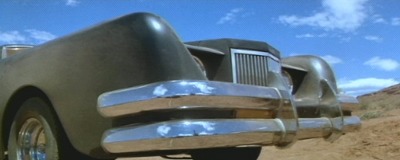
Watching a movie on the SciFi Channel, it's another one of my favorite just plain bad old films. Created in 1977, The Car is to me one of those cult classics.
As this reviewer says:
There is good reason why THE CAR is a cult classic. It has a loopy premise that is hard to dislike, a really boss vehicle (if Ultimate Evil came to earth as a car in the seventies, I'd bet good money that it would look like that), and more than enough energy in its attack scenes for the forgiving viewer to admit that this movie is pretty darn fun on its own terms. It certainly is one of my most cherished guilty pleasures from childhood and movie I never grow bored watching. Heck, after writing this, I'd watch it again (and I just did). Enjoy.
I am.
As was said on the imdb site, you can forget just about everything from the movie other than the sound of that horn. I need to get the DVD and capture the sound.
Watching a movie on the SciFi Channel, it's another one of my favorite just plain bad old films. Created in 1977, The Car is to me one of those cult classics.
As this reviewer says:
There is good reason why THE CAR is a cult classic. It has a loopy premise that is hard to dislike, a really boss vehicle (if Ultimate Evil came to earth as a car in the seventies, I'd bet good money that it would look like that), and more than enough energy in its attack scenes for the forgiving viewer to admit that this movie is pretty darn fun on its own terms. It certainly is one of my most cherished guilty pleasures from childhood and movie I never grow bored watching. Heck, after writing this, I'd watch it again (and I just did). Enjoy.
I am.
As was said on the imdb site, you can forget just about everything from the movie other than the sound of that horn. I need to get the DVD and capture the sound.
Saturday, May 22, 2004
Which One Are You?
Elrond was always one of my favorite LOTR characters.
Here was my wife's results:
Wonder what that means for our kids.....
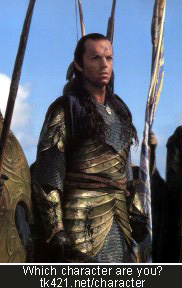
"A stern yet benevolent organizer who often knows best, your wits are keenly fixed on aiding efforts you deem worthy.
'Now at this last we must take a hard road, a road unforseen. There lies our hope, if hope it be. To walk into peril to Mordor.'
Elrond is a character in the Middle-Earth universe. TheOneRing.net has a short biography."
Elrond was always one of my favorite LOTR characters.
Here was my wife's results:
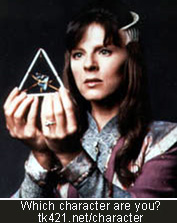
"Devoutly dedicated to helping lead others to glory, you are a strong, supportive, and spiritual caregiver.
'Summoned, I take the place that has been prepared for me.'
Delenn is a character in the Babylon 5 universe. You can read her biography at the Worlds of JMS fansite."
Wonder what that means for our kids.....
Saturday, April 17, 2004
Hello Again
Wow, only April, and this is my first post this year. I do this every so often, write a lot, then disappear for a few months. So where have I been? NMP Consulting, the business I started in 2002 is taking off. We've several employees and independent contractors, and we're keeping real busy. It's why I haven't posted here in a looooong time. Just haven't had the time to sit down and type out an interesting post.
NMP has a newly created IT Forum. Stop by and post your questions and we'll try to help you out. We'll be opening up a IT News site (to go along with the 10 million other ones out there) soon, so look for info here.
Hopefully I'll have time to type out a few words here soon, and hopefully I'll be able to continue to hire people and grow my business, though I don't think they labor department is counting my new employees in the employment numbers. I've noticed that a lot of people I am talking to have dropped out of the corporate rat-race and have started their own business'. Unfortunately, those numbers don't show up in the 'official' government numbers. It would be nice to know just how many people there are just like me, and what the real numbers are.
Oh well....we'll never know.
Catch all of you out there on the Information Superhighway soon, just look in your rearview mirror for the Porkchop Express.
Wow, only April, and this is my first post this year. I do this every so often, write a lot, then disappear for a few months. So where have I been? NMP Consulting, the business I started in 2002 is taking off. We've several employees and independent contractors, and we're keeping real busy. It's why I haven't posted here in a looooong time. Just haven't had the time to sit down and type out an interesting post.
NMP has a newly created IT Forum. Stop by and post your questions and we'll try to help you out. We'll be opening up a IT News site (to go along with the 10 million other ones out there) soon, so look for info here.
Hopefully I'll have time to type out a few words here soon, and hopefully I'll be able to continue to hire people and grow my business, though I don't think they labor department is counting my new employees in the employment numbers. I've noticed that a lot of people I am talking to have dropped out of the corporate rat-race and have started their own business'. Unfortunately, those numbers don't show up in the 'official' government numbers. It would be nice to know just how many people there are just like me, and what the real numbers are.
Oh well....we'll never know.
Catch all of you out there on the Information Superhighway soon, just look in your rearview mirror for the Porkchop Express.
Tuesday, December 16, 2003
#1 on Shallow Jack's Christmas List
Shallow Jack here. Which means everything that follows is probably NOT SAFE FOR WORK.
I know these "items" have been discussed already on the Howard Stern show, but even though Shallow Jack wouldn't be the primary choice as a speaker at any women's group conventions (other than maybe the annual Porn Stars shindigs), I don't listen to Stern very often. After about 2 or 3 of Stern's shows, you've heard all the rest.
So I'm surfing my normal tech and pr0n sites, and come across a geek christmas list over on Slashdot. Yes, Slashdot, the site where Cybersnobbery gets it's first name.
One of the 'commenters' talks about wanting a "RealDoll" for Christmas.
WARNING: If you click on that link, you will find yourself on the pathway to credit debt hell and a very angry spouse should you order one. You might also find yourself escorted out of your place of employment.
But Shallow Jack says that shouldn't stop you.
"Dear Santa,
I know I've not been the best of boys this year. Surfing pr0n, and lusting after hip-hugger wearing, belly-shirt showing, pushup-bra under low-cut shirt donned women is not conducive to getting oneself moved from the permanent "Naughty" list to the "Nice" roll.
But I want one of these.
Think of it as headache/I'm tired/I don't feel like it/The kids might hear/etc." medicine for ol' Shallow Jack's wife. He'll be nice and leave her alone, having his new toy to play with.
And she's been a very good girl.
Too good if you ask Shallow Jack. But I digress.
Just to let you know Santa, if you're embarassed about delivering a 110-pound female body-3 type model to Jack's place, or it won't fit in the sleigh, a check for $5999 + $450 shipping would be just fine.
Yes, that is a lot of money, but its amazing how almost real they look. Much better than "Blow-up Betty" that most guys think of when it comes to these sort of things.
Don't worry about me breaking it, as it can "safely support 400 lbs of weight", and I've been a good boy and slimmed down on my low-carb diet. Also "REALDOLL's silicone skin is extremely flexible and will sustain almost any reasonable position.", though I really want to know what they mean by 'reasonable'.
Also Santa, if you think Shallow Jack's been a very good boy this year, you can add in some extra money for the options, like $3000.00 for the "articulated hands", or $500.00 for a custom wig. The geek in me wants the $1500.00 "Interactive sensory response system" so the real doll makes computer controlled noises while I'm playing with her, and oh yes, the beta "Hip Gyration system" unit sounds interesting, but since "The unit runs on 24 volts DC, and is UL Listed. The actuator itself has been able to lift up to 500 lbs and uses a state of the art control system which includes an automatic clutch system that will allow slippage if too much weight is present. This eliminates the possibility of damaging the actuator or the Realdoll." and it is only in testing at this time, I think I'll pass. Sounds like it could damage certain of Shallow Jack's own favorite body parts.
Shallow Jack likes his manhood in tact. What also bothers me is that the computer controlled system runs on Windows. So what happens when it crashes? I don't want to know.
Oh Santa, if you've got any ladies on your "Naughty but Nice" list, there's a Male Version of the doll as well.
Or you could just give them Shallow Jack's phone number.
Thanks for reading Santa!"
Shallow Jack here. Which means everything that follows is probably NOT SAFE FOR WORK.
I know these "items" have been discussed already on the Howard Stern show, but even though Shallow Jack wouldn't be the primary choice as a speaker at any women's group conventions (other than maybe the annual Porn Stars shindigs), I don't listen to Stern very often. After about 2 or 3 of Stern's shows, you've heard all the rest.
So I'm surfing my normal tech and pr0n sites, and come across a geek christmas list over on Slashdot. Yes, Slashdot, the site where Cybersnobbery gets it's first name.
One of the 'commenters' talks about wanting a "RealDoll" for Christmas.
WARNING: If you click on that link, you will find yourself on the pathway to credit debt hell and a very angry spouse should you order one. You might also find yourself escorted out of your place of employment.
But Shallow Jack says that shouldn't stop you.
"Dear Santa,
I know I've not been the best of boys this year. Surfing pr0n, and lusting after hip-hugger wearing, belly-shirt showing, pushup-bra under low-cut shirt donned women is not conducive to getting oneself moved from the permanent "Naughty" list to the "Nice" roll.
But I want one of these.
Think of it as headache/I'm tired/I don't feel like it/The kids might hear/etc." medicine for ol' Shallow Jack's wife. He'll be nice and leave her alone, having his new toy to play with.
And she's been a very good girl.
Too good if you ask Shallow Jack. But I digress.
Just to let you know Santa, if you're embarassed about delivering a 110-pound female body-3 type model to Jack's place, or it won't fit in the sleigh, a check for $5999 + $450 shipping would be just fine.
Yes, that is a lot of money, but its amazing how almost real they look. Much better than "Blow-up Betty" that most guys think of when it comes to these sort of things.
Don't worry about me breaking it, as it can "safely support 400 lbs of weight", and I've been a good boy and slimmed down on my low-carb diet. Also "REALDOLL's silicone skin is extremely flexible and will sustain almost any reasonable position.", though I really want to know what they mean by 'reasonable'.
Also Santa, if you think Shallow Jack's been a very good boy this year, you can add in some extra money for the options, like $3000.00 for the "articulated hands", or $500.00 for a custom wig. The geek in me wants the $1500.00 "Interactive sensory response system" so the real doll makes computer controlled noises while I'm playing with her, and oh yes, the beta "Hip Gyration system" unit sounds interesting, but since "The unit runs on 24 volts DC, and is UL Listed. The actuator itself has been able to lift up to 500 lbs and uses a state of the art control system which includes an automatic clutch system that will allow slippage if too much weight is present. This eliminates the possibility of damaging the actuator or the Realdoll." and it is only in testing at this time, I think I'll pass. Sounds like it could damage certain of Shallow Jack's own favorite body parts.
Shallow Jack likes his manhood in tact. What also bothers me is that the computer controlled system runs on Windows. So what happens when it crashes? I don't want to know.
Oh Santa, if you've got any ladies on your "Naughty but Nice" list, there's a Male Version of the doll as well.
Or you could just give them Shallow Jack's phone number.
Thanks for reading Santa!"
Tuesday, November 25, 2003
Hacking Voting Machines
I came across this article while perusing Security Focus' Website. It talks about how insecure the electronic voting machines that Diebold, an Ohio company, manufactures. Pretty interesting stuff, though there are links in the article to anti-war sites, and near the end the column takes on an all-too-often "Linux is great, everything else sucks" sort of tone when referring to electronic voting machines in Australia.
I was surprised to read that voting results were transmitted across the internet.
Pretty frightening to me.
I came across this article while perusing Security Focus' Website. It talks about how insecure the electronic voting machines that Diebold, an Ohio company, manufactures. Pretty interesting stuff, though there are links in the article to anti-war sites, and near the end the column takes on an all-too-often "Linux is great, everything else sucks" sort of tone when referring to electronic voting machines in Australia.
I was surprised to read that voting results were transmitted across the internet.
Pretty frightening to me.
Monday, November 24, 2003
The Hell of Blackouts
An interim report on the August 14th US-Canada blackout was recently released. The document is over 130 pages, and talks about several causes of the blackout, but the most interesting thing is that it seems that when it started no one knew what was happening due to computer malfunctions.
The report starts with an Executive-type review of the way the systems interact due to the difficulty of storing and transmitting electricity. One of the inaccuracies in the report state that electricity travels at the speed of light. I had myself been taught 250mph by one of my Ohio State University Physics Professors, but it appears that is wrong as you can read about here and here. It is interesting, but dry. I don't blame the report writers for not being so accurate about a scientific fact, due to their final target audience, but it makes one wonder what else they 'glossed over' in their 'interim' report.
The main computer system that monitors the electrical grid for FirstEnergy (FE) in Ohio (just a few hours north of where Jack lives, and the start of the blackout) is the GE Harris XA/21 EMS system. According to the documentation, it is a UNIX based system that uses the TCP/IP network protocols (the same ones you use everyday on the internet), ODBC (Open DataBase Connectivity) standards to a SQL (Standard Query Language) POSIX-compliant Database backend. The system is programmed in ANSI C and FORTRAN.
What this essentially means, and as in indicated in the brochure, is that it uses "Open Systems". Which is industry standard protocols and programming interfaces that allow any other types of systems to connect to it.
It's kind of how the Internet works.
Pretty much everything on the Internet uses "Open Standards", or you'd be downloading a new program everytime you visit a new website.
Now, for all of you Conspiracy Theorists, time to get out your foil hats. (I've been harping on the foil hats a lot lately).
James over a Hell In A Handbasket tends to "pooh-pooh" the possible threats of a cyberattack, but I think this is a case that proves it could do a lot of damage if launched against the right targets.
The shit really started to hit the fan at 12:15 PM ESDT, about 3 hours before the blackout.
Oh, did I mention that the FE's GE XA/21 systems' software hadn't been updated since 1998? Guess how many Unix-type operating system vulnerabilities have been released in that 5-year period? Lots. Who knows what other modules the system was running? But I digress.
Anyway, just after Noon, one of the monitoring systems quit working due to "inaccurate data" (buffer overflow anyone?). However, no one at the main control center knew it. This caused another large generation unit in Eastlake to shutdown around 1:30 PM, and around 2:15 PM the alarm and logging computer system (that darned XA/21) was completely dead and useless. At 3:05 the whole blackout started and quickly put millions of people into darkness.
We're lucky that more people didn't end up hurt during that outage.
Losing the Eastlake plant itself didn't cause the blackout, but because the computer system was FUBAR'd, no one knew what was going on. The report says that the fact that operators were unaware of what was going on due to the computer failure, and the lines falling into trees were the two main reasons for the blackout.
OK - It wasn't that no one knew what was happening, in fact one of the employees of FE called around to get some things reconfigured to support the high-load that was happening that day, but because of the monitoring system failure, he wasn't working with enough information. In fact, someone figured out that a monitoring device had failed, and turned the system off to correct the error, but then went to lunch, forgetting to turn the monitoring system back on. Even though the monitors run every 5 minutes, no one noticed it wasn't working right until an hour-and-a-half later.
So someone turned it back on.
But by now the data that was coming across was bad, and while a systems engineer identified the possible problem with the grid at about 2 PM and finally called the main operator an hour later, the main operator mistakenly saw that everything was running fine. It took another 20 minutes to get that straightened out, and then another 20 minutes to get the system reporting everything correctly.
That was 2 minutes before it all went to hell.
You see, about 2 hours before that, the alarm and logging system had went down.
At about 2:14, the system wasn't reporting anything of any use. In the next 30 minutes, FE lost the primary and backup server completely. Both systems died? The report doesn't say conclusively how they failed (though some theories are discussed later).
But guess what? No one monitoring the system noticed the servers had crashed for an hour.
Guess Homer had too many donuts that day.
AEP had even called FE to report problems, but of course since the system was down, FE reported no alarms to logged problems. DOH! The backup server had failed 13 minutes after the primary server, but still no one noticed.
Well, no one WORKING noticed.
The system did automatically page the IT staff.
Everyone who works at the building with IT staff knows that things can go wrong, but the IT staff doesn't tell anyone, other than "we've got a system down and we're working on it".
Don't want to look bad, ya know?
The report supposes that data "overflowed the process' input buffers" (see buffer overflow above) in the system, which caused the alarm system failure. This means that neither the server or the remote terminals spewed out any data about the grid problems. Oops.
Since the data overflow wasn't stopped, when the system transferred over to the backups, the backup servers failed as well under the data load.
This overflow, as it was happening, caused the refresh rate on the operator's screen to refresh only once every minute, as compared to every 1 to 3 seconds as normal. These screens are also "nested" underneath the top level screens that the operators view, thus slowing things down to a crawl.
By now the IT guys arrived, and "warm booted" (reboot without power off) the systems. The IT guys checked the servers and saw that all was good, but never verified with the control room operators that the alarm system was functioning again.
"Just reboot it, and we can go home guys, no one will notice that anything major was wrong".
What's interesting is that the operators hadn't noticed the real problem. They hadn't called about the alarm system problem until about an hour after the IT staff started working on things (and had 'fixed' it 30 minutes before).
The alarm system displays had "flat-lined" (didn't go to zero, but just stayed at where they had been at the point of failure, which would be unusual due to normal voltage changes in the grid) and no one seemed to notice or care.
Once they did figure out what was wrong, it was too late. The cascade had started, and the operators didn't want the IT staff to "cold-boot" (power off and restart) all the systems, because they were afraid that they wouldn't have any data after that, even though what they had was pretty useless.
The rest is history.
I don't know if these systems are connected in any way to the Internet, but I'd be surprised if they weren't. 100% isolation of a private network is difficult to maintain these days. Someone somewhere always hooks something up to help them get easier access to resources they need. If someone mounted a concerted effort against utility and power systems through these connections, it would be easy to see how it could get many people hurt or killed.
It's all the computers fault.
Really.
An interim report on the August 14th US-Canada blackout was recently released. The document is over 130 pages, and talks about several causes of the blackout, but the most interesting thing is that it seems that when it started no one knew what was happening due to computer malfunctions.
The report starts with an Executive-type review of the way the systems interact due to the difficulty of storing and transmitting electricity. One of the inaccuracies in the report state that electricity travels at the speed of light. I had myself been taught 250mph by one of my Ohio State University Physics Professors, but it appears that is wrong as you can read about here and here. It is interesting, but dry. I don't blame the report writers for not being so accurate about a scientific fact, due to their final target audience, but it makes one wonder what else they 'glossed over' in their 'interim' report.
The main computer system that monitors the electrical grid for FirstEnergy (FE) in Ohio (just a few hours north of where Jack lives, and the start of the blackout) is the GE Harris XA/21 EMS system. According to the documentation, it is a UNIX based system that uses the TCP/IP network protocols (the same ones you use everyday on the internet), ODBC (Open DataBase Connectivity) standards to a SQL (Standard Query Language) POSIX-compliant Database backend. The system is programmed in ANSI C and FORTRAN.
What this essentially means, and as in indicated in the brochure, is that it uses "Open Systems". Which is industry standard protocols and programming interfaces that allow any other types of systems to connect to it.
It's kind of how the Internet works.
Pretty much everything on the Internet uses "Open Standards", or you'd be downloading a new program everytime you visit a new website.
Now, for all of you Conspiracy Theorists, time to get out your foil hats. (I've been harping on the foil hats a lot lately).
James over a Hell In A Handbasket tends to "pooh-pooh" the possible threats of a cyberattack, but I think this is a case that proves it could do a lot of damage if launched against the right targets.
The shit really started to hit the fan at 12:15 PM ESDT, about 3 hours before the blackout.
Oh, did I mention that the FE's GE XA/21 systems' software hadn't been updated since 1998? Guess how many Unix-type operating system vulnerabilities have been released in that 5-year period? Lots. Who knows what other modules the system was running? But I digress.
Anyway, just after Noon, one of the monitoring systems quit working due to "inaccurate data" (buffer overflow anyone?). However, no one at the main control center knew it. This caused another large generation unit in Eastlake to shutdown around 1:30 PM, and around 2:15 PM the alarm and logging computer system (that darned XA/21) was completely dead and useless. At 3:05 the whole blackout started and quickly put millions of people into darkness.
We're lucky that more people didn't end up hurt during that outage.
Losing the Eastlake plant itself didn't cause the blackout, but because the computer system was FUBAR'd, no one knew what was going on. The report says that the fact that operators were unaware of what was going on due to the computer failure, and the lines falling into trees were the two main reasons for the blackout.
OK - It wasn't that no one knew what was happening, in fact one of the employees of FE called around to get some things reconfigured to support the high-load that was happening that day, but because of the monitoring system failure, he wasn't working with enough information. In fact, someone figured out that a monitoring device had failed, and turned the system off to correct the error, but then went to lunch, forgetting to turn the monitoring system back on. Even though the monitors run every 5 minutes, no one noticed it wasn't working right until an hour-and-a-half later.
So someone turned it back on.
But by now the data that was coming across was bad, and while a systems engineer identified the possible problem with the grid at about 2 PM and finally called the main operator an hour later, the main operator mistakenly saw that everything was running fine. It took another 20 minutes to get that straightened out, and then another 20 minutes to get the system reporting everything correctly.
That was 2 minutes before it all went to hell.
You see, about 2 hours before that, the alarm and logging system had went down.
At about 2:14, the system wasn't reporting anything of any use. In the next 30 minutes, FE lost the primary and backup server completely. Both systems died? The report doesn't say conclusively how they failed (though some theories are discussed later).
But guess what? No one monitoring the system noticed the servers had crashed for an hour.
Guess Homer had too many donuts that day.
AEP had even called FE to report problems, but of course since the system was down, FE reported no alarms to logged problems. DOH! The backup server had failed 13 minutes after the primary server, but still no one noticed.
Well, no one WORKING noticed.
The system did automatically page the IT staff.
Everyone who works at the building with IT staff knows that things can go wrong, but the IT staff doesn't tell anyone, other than "we've got a system down and we're working on it".
Don't want to look bad, ya know?
The report supposes that data "overflowed the process' input buffers" (see buffer overflow above) in the system, which caused the alarm system failure. This means that neither the server or the remote terminals spewed out any data about the grid problems. Oops.
Since the data overflow wasn't stopped, when the system transferred over to the backups, the backup servers failed as well under the data load.
This overflow, as it was happening, caused the refresh rate on the operator's screen to refresh only once every minute, as compared to every 1 to 3 seconds as normal. These screens are also "nested" underneath the top level screens that the operators view, thus slowing things down to a crawl.
By now the IT guys arrived, and "warm booted" (reboot without power off) the systems. The IT guys checked the servers and saw that all was good, but never verified with the control room operators that the alarm system was functioning again.
"Just reboot it, and we can go home guys, no one will notice that anything major was wrong".
What's interesting is that the operators hadn't noticed the real problem. They hadn't called about the alarm system problem until about an hour after the IT staff started working on things (and had 'fixed' it 30 minutes before).
The alarm system displays had "flat-lined" (didn't go to zero, but just stayed at where they had been at the point of failure, which would be unusual due to normal voltage changes in the grid) and no one seemed to notice or care.
Once they did figure out what was wrong, it was too late. The cascade had started, and the operators didn't want the IT staff to "cold-boot" (power off and restart) all the systems, because they were afraid that they wouldn't have any data after that, even though what they had was pretty useless.
The rest is history.
I don't know if these systems are connected in any way to the Internet, but I'd be surprised if they weren't. 100% isolation of a private network is difficult to maintain these days. Someone somewhere always hooks something up to help them get easier access to resources they need. If someone mounted a concerted effort against utility and power systems through these connections, it would be easy to see how it could get many people hurt or killed.
It's all the computers fault.
Really.
Monday, November 17, 2003
Now Jack's Heard Everything
It's getting harder and harder to keep computer systems patched with the latest updates and fixes. It's a real problem of resource management in many IT shops today.
So now we're told that we need to watch out forvirus writers from outer space.
I don't believe it. This guy watched Independance Day (ID4) too many times. You know, when Jeff Goldblum took his Mac iBook up to the mothership and introduced a virus in their system that caused havok.
Heck, we can't even get our own systems to integrate correctly. How's an alien species going to hack our operating systems without knowing anything about them.
You know Mr. Carrigan wears a tin foil hat to go along with his tin foil wallpaper.
Sheesh.
It's getting harder and harder to keep computer systems patched with the latest updates and fixes. It's a real problem of resource management in many IT shops today.
So now we're told that we need to watch out forvirus writers from outer space.
I don't believe it. This guy watched Independance Day (ID4) too many times. You know, when Jeff Goldblum took his Mac iBook up to the mothership and introduced a virus in their system that caused havok.
Heck, we can't even get our own systems to integrate correctly. How's an alien species going to hack our operating systems without knowing anything about them.
You know Mr. Carrigan wears a tin foil hat to go along with his tin foil wallpaper.
Sheesh.
Thursday, November 06, 2003
Matrix Revolutions (No Spoiler)
Just finished seeing it. What is nice about the series is that you can basically watch the first one, and the story is finished. The rest is just a wild acid trip. I've been drunk, but never stoned - though now I think I have an appreciation as to what it feels like.
As far as Matrix Revoltions go, I only have three letters to say about it:
Just finished seeing it. What is nice about the series is that you can basically watch the first one, and the story is finished. The rest is just a wild acid trip. I've been drunk, but never stoned - though now I think I have an appreciation as to what it feels like.
As far as Matrix Revoltions go, I only have three letters to say about it:

(Explanation: First one is in "Matrix Code" Font, Second is in "Matrix Schedule" font.)
Tuesday, November 04, 2003
Cool Weaponry
I probably should have forwarded this on to Anna for comment, as in my perusing I was directed to an article about microwave weapons the military is developing.
It's really cool. Especially the part about how the directed beam versions have to be "pulsed", unless you want to create a bit of white-hot plasma.
Ahhhh, makes one think of one of my favorite Arnie scenes:
The Terminator: The .45 Long Slide, with laser sighting.
Alamo Guns Clerk: These are brand new; we just got these in. That's a good gun. Just touch the trigger, the beam comes on and you put the red dot where you want the bullet to go. You can't miss. Anything else?
The Terminator: Phased-plasma rifle in the forty watt range.
Alamo Guns Clerk: Hey, just what you see, pal.
Sounds like Plasma-rifles are just around the corner.
I probably should have forwarded this on to Anna for comment, as in my perusing I was directed to an article about microwave weapons the military is developing.
It's really cool. Especially the part about how the directed beam versions have to be "pulsed", unless you want to create a bit of white-hot plasma.
Ahhhh, makes one think of one of my favorite Arnie scenes:
The Terminator: The .45 Long Slide, with laser sighting.
Alamo Guns Clerk: These are brand new; we just got these in. That's a good gun. Just touch the trigger, the beam comes on and you put the red dot where you want the bullet to go. You can't miss. Anything else?
The Terminator: Phased-plasma rifle in the forty watt range.
Alamo Guns Clerk: Hey, just what you see, pal.
Sounds like Plasma-rifles are just around the corner.
Hats, Caps, Stetsons, Fedoras = Linux
The big news in the Linux world is that RedHat is no longer going to support the current versions of its RedHat Linux (6.x, 7.x, 8.0, and 9.0) after this coming April. Some think this means the sky is falling.
Of course, as this reply to the Slashdot article says, its hardly that. In fact, as several of the linked articles state, RedHat is pushing people towards Fedora, which is basically the beta of the next version of RedHat. I'm looking forward to the changes, as Fedora is supposed to be more "bleeding edge" with updates, something 'normal' RedHat Linux was slow to adopt, because of the testing that goes into a product that a commercial company charges for.
If you read the Zone-H article, it would seem that its the end for "free software" ala Linux. It's time to move to some version of BSD or other 'free' distributions of Linux. Of course, there are literally hundreds of available distros for Linux. The author of the article even begins whining...well you read it:
"WhiteHat should be the 'good' hackers, while 'BlackHat' the bad ones (the bad guys). What does RED stands for ? If you hope it was meant for communism.... it looks dramaticaly just like the passage from Lenin to Stalin: from revolution, spirit of freedom and unity of people, to just another dictatorship. Thank you RedHat."
So Communism is good, Dictatorship is bad.
Actually, both are bad. Which is why Linux is going more commercial. Find something that is useful. Improve it, like RedHat (or any of the other distros compiled by commercial companies) did, and then charge for your efforts. It's the way commerce works.
But many of these Linux zealots seem like they are straight out of the 60's with communal farming = community programming.
It just doesn't work in the long run.
Since the core of Linux will always be free unless the GPL is revoked, anyone has the ability to roll your own. So quit whining, you want free stuff? Build it yourself. You want a nice packaged deal that does all the work for you? Pay the people who take the time to do it. Since the Fedora project takes input from the users and developers who get it for free, they are paying for the distro with the labor. It's still not free.
The big news in the Linux world is that RedHat is no longer going to support the current versions of its RedHat Linux (6.x, 7.x, 8.0, and 9.0) after this coming April. Some think this means the sky is falling.
Of course, as this reply to the Slashdot article says, its hardly that. In fact, as several of the linked articles state, RedHat is pushing people towards Fedora, which is basically the beta of the next version of RedHat. I'm looking forward to the changes, as Fedora is supposed to be more "bleeding edge" with updates, something 'normal' RedHat Linux was slow to adopt, because of the testing that goes into a product that a commercial company charges for.
If you read the Zone-H article, it would seem that its the end for "free software" ala Linux. It's time to move to some version of BSD or other 'free' distributions of Linux. Of course, there are literally hundreds of available distros for Linux. The author of the article even begins whining...well you read it:
"WhiteHat should be the 'good' hackers, while 'BlackHat' the bad ones (the bad guys). What does RED stands for ? If you hope it was meant for communism.... it looks dramaticaly just like the passage from Lenin to Stalin: from revolution, spirit of freedom and unity of people, to just another dictatorship. Thank you RedHat."
So Communism is good, Dictatorship is bad.
Actually, both are bad. Which is why Linux is going more commercial. Find something that is useful. Improve it, like RedHat (or any of the other distros compiled by commercial companies) did, and then charge for your efforts. It's the way commerce works.
But many of these Linux zealots seem like they are straight out of the 60's with communal farming = community programming.
It just doesn't work in the long run.
Since the core of Linux will always be free unless the GPL is revoked, anyone has the ability to roll your own. So quit whining, you want free stuff? Build it yourself. You want a nice packaged deal that does all the work for you? Pay the people who take the time to do it. Since the Fedora project takes input from the users and developers who get it for free, they are paying for the distro with the labor. It's still not free.
Monday, November 03, 2003
Trust No One!
That was the mantra of an old favorite Role Playing Game of mine, "Paranoia". (Before they ruined it with the 2nd edition)
So, back to the point.
I'm working on a client's computer this weekend. It has two problems, CPU Utilization in Windows XP is a constant 100%, and Microsoft Word would not open any files. So I start poking around with the obvious things. Spyware and Viruses.
The computer already has Norton Internet Security on it (up to date), and the user ran Adaware multiple times. With the CPU being at 100%, I didn't want to try to run anything on it. Besides, if it was compromised, it wouldn't have done any good. So off comes the cover, out comes the hard drive, and in it goes to my forensics workstation, which has several versions of different scanners of different types.
So I run Command Antivirus, Norton Antivirus, Trend Micro's Housecall Web-based Free Scanner, Spybot Search and Destroy, Adaware (again), McAfee's AntiVirus, Grisoft's AVG. Basically, the kitchen sink of scanners.
Nothing.
Didn't find a thing, and CPU was still at 100% when the Hard Drive was replaced.
OK - System process was using 80-90% of CPU time. That usually indicates a device driver using the wrong version (Say for Windows ME, which this machine originally had installed.)
Check all the drivers by hand. All are the Digitally Signed XP versions. Shoot. No dice.
Check the registry (where I should have started). Found buried in an obscure section a reference to 'server.exe' (Sub7 trojan program) and 'systray.exe' where it shouldn't have been (another Trojan). Removed those two files, reboot.
System works fine now.
The date on the Trojans were October 24th, 2003. I took the hard drive out of a system and scanned it in another, yet it never found those two programs (One in C:\ and the other in C:\Windows\System32) even though they were in non-hidden directories. The drive was even formatted in FAT32, so it didn't have anything to do with file permissions or ownership. The Anti-Virus program on the system had been there for 8 months and was kept up to date.
Still feel protected by your Anti-virus programs?
Think again.
Just be careful using your system.
That was the mantra of an old favorite Role Playing Game of mine, "Paranoia". (Before they ruined it with the 2nd edition)
So, back to the point.
I'm working on a client's computer this weekend. It has two problems, CPU Utilization in Windows XP is a constant 100%, and Microsoft Word would not open any files. So I start poking around with the obvious things. Spyware and Viruses.
The computer already has Norton Internet Security on it (up to date), and the user ran Adaware multiple times. With the CPU being at 100%, I didn't want to try to run anything on it. Besides, if it was compromised, it wouldn't have done any good. So off comes the cover, out comes the hard drive, and in it goes to my forensics workstation, which has several versions of different scanners of different types.
So I run Command Antivirus, Norton Antivirus, Trend Micro's Housecall Web-based Free Scanner, Spybot Search and Destroy, Adaware (again), McAfee's AntiVirus, Grisoft's AVG. Basically, the kitchen sink of scanners.
Nothing.
Didn't find a thing, and CPU was still at 100% when the Hard Drive was replaced.
OK - System process was using 80-90% of CPU time. That usually indicates a device driver using the wrong version (Say for Windows ME, which this machine originally had installed.)
Check all the drivers by hand. All are the Digitally Signed XP versions. Shoot. No dice.
Check the registry (where I should have started). Found buried in an obscure section a reference to 'server.exe' (Sub7 trojan program) and 'systray.exe' where it shouldn't have been (another Trojan). Removed those two files, reboot.
System works fine now.
The date on the Trojans were October 24th, 2003. I took the hard drive out of a system and scanned it in another, yet it never found those two programs (One in C:\ and the other in C:\Windows\System32) even though they were in non-hidden directories. The drive was even formatted in FAT32, so it didn't have anything to do with file permissions or ownership. The Anti-Virus program on the system had been there for 8 months and was kept up to date.
Still feel protected by your Anti-virus programs?
Think again.
Just be careful using your system.
Wednesday, October 29, 2003
Dumbass Disposable DVDs
A while ago, there were several articles about the idea of selling disposable DVDs. The idea was that the DVDs would be encased in an airtight package, and once opened and exposed to the air would begin to darken to the point that after 48 hours they would be unusable. This way you didn't have to return the DVDs to the rental store. No late fees, no hassle, you just throw them away.
Sure, a nightmare for the environmentalist wackos among us, but it could work.
Blockbuster rents DVDs for $4.29 around here, and with the ability to buy the latest releases at the local Walmart for $14-$16, it's just not worth renting anymore. I'd rather spend the extra few bucks and buy it straight out.
So I liked the idea of throwaway DVDs, almost no retail overhead for the manufacturers, so I thought it would be cheaper.
So along comes "EZ-D", the throwaways in test markets.
As you can see from the article, they aren't going over too well. At $7 a pop, I'm not surprised. What are they thinking? SEVEN dollars for two days of viewing? Again, when you can buy the non-disposable ones for just a little more why would you buy throw-aways for such a price? Sell them for $2-$3, and I'm in; otherwise forget it. Hopefully their test market data will tell them that.
A while ago, there were several articles about the idea of selling disposable DVDs. The idea was that the DVDs would be encased in an airtight package, and once opened and exposed to the air would begin to darken to the point that after 48 hours they would be unusable. This way you didn't have to return the DVDs to the rental store. No late fees, no hassle, you just throw them away.
Sure, a nightmare for the environmentalist wackos among us, but it could work.
Blockbuster rents DVDs for $4.29 around here, and with the ability to buy the latest releases at the local Walmart for $14-$16, it's just not worth renting anymore. I'd rather spend the extra few bucks and buy it straight out.
So I liked the idea of throwaway DVDs, almost no retail overhead for the manufacturers, so I thought it would be cheaper.
So along comes "EZ-D", the throwaways in test markets.
As you can see from the article, they aren't going over too well. At $7 a pop, I'm not surprised. What are they thinking? SEVEN dollars for two days of viewing? Again, when you can buy the non-disposable ones for just a little more why would you buy throw-aways for such a price? Sell them for $2-$3, and I'm in; otherwise forget it. Hopefully their test market data will tell them that.
Monday, October 27, 2003
In My (And Every Other Man's) Dreams
I am willing to make a bet that many of us men can get our wives/fiances/girlfriends to read this one, and not look at the URL.
I'm going to give it the old college try.
Jack's willing to volunteer for any women out there who want to see if this is indeed true. Just drop me an e-mail, I'm willing to travel.
I am willing to make a bet that many of us men can get our wives/fiances/girlfriends to read this one, and not look at the URL.
I'm going to give it the old college try.
Jack's willing to volunteer for any women out there who want to see if this is indeed true. Just drop me an e-mail, I'm willing to travel.
Sunday, October 26, 2003
I Couldn't Believe My Ears
So I'm flipping channels on my Hauppauge WinTV device that allows me to watch TV on my computer. Yes, it's the ultimate in sensory overload; TV and the Internet.
Anyway, I flip over to Fox News, my preferred Cable News Channel (like that's a surprise), and there's Geraldo. Yes, Geraldo, who couldn't get a good gig anywhere (for good reason), and Fox has him because he's a left-leaner and they picked him up back when the Big 3 networks noticed that Fox was taking some of their viewers. Well, in their attempt to paint Fox as being the extreme right-wing news source, they caused the upper muckity-mucks at Fox to hire Geraldo for some 'balance', and now they're stuck with him.
Even if he did get kicked out of Iraq.
So, here he is on his show (which I didn't even know he had), talking about the Kobe Bryant case (which I could give a shit about), and in a straight face he's speaking about dried semen and pubic hair on the victim's underwear. He also has some Forensic Pathologist there, whom he's asking how accurate the science is for determining how old the crusty spooge is.
Please Fox, dump Geraldo and quit reprinting AP stories on your website.
Please.
I'll even pay for a subscription.
So I'm flipping channels on my Hauppauge WinTV device that allows me to watch TV on my computer. Yes, it's the ultimate in sensory overload; TV and the Internet.
Anyway, I flip over to Fox News, my preferred Cable News Channel (like that's a surprise), and there's Geraldo. Yes, Geraldo, who couldn't get a good gig anywhere (for good reason), and Fox has him because he's a left-leaner and they picked him up back when the Big 3 networks noticed that Fox was taking some of their viewers. Well, in their attempt to paint Fox as being the extreme right-wing news source, they caused the upper muckity-mucks at Fox to hire Geraldo for some 'balance', and now they're stuck with him.
Even if he did get kicked out of Iraq.
So, here he is on his show (which I didn't even know he had), talking about the Kobe Bryant case (which I could give a shit about), and in a straight face he's speaking about dried semen and pubic hair on the victim's underwear. He also has some Forensic Pathologist there, whom he's asking how accurate the science is for determining how old the crusty spooge is.
Please Fox, dump Geraldo and quit reprinting AP stories on your website.
Please.
I'll even pay for a subscription.
Saturday, October 25, 2003
Updated Redhat 9 Java Installtion for Mozilla 1.5
A while back I posted instructions to installing the Java plugin for Mozilla on RedHat 9 Linux. I've added a section for Mozilla 1.5 and the new J2re1.4.2_02 version of the Java Runtime Engine and Plugin.
If you're stuck, like I was (again), go there and check it out.
Oh, and I would suggest running Mozilla Firebird as a browser on Linux OR Windows. IE is no longer my default browser due to all of the recent security problems plaguing it. These vulnerabilities allow all of this damn spyware that innundates everyone's computers these days to be installed without the user's knowledge simply by visiting a website. Do yourself a favor and try it out. Save yourself some time and get the Windows Installer Version of Firebird 0.7 by clicking here. Otherwise you'll have to unzip it yourself, put it in the right places, and make registry changes.
Yup, the installer is easier.
A while back I posted instructions to installing the Java plugin for Mozilla on RedHat 9 Linux. I've added a section for Mozilla 1.5 and the new J2re1.4.2_02 version of the Java Runtime Engine and Plugin.
If you're stuck, like I was (again), go there and check it out.
Oh, and I would suggest running Mozilla Firebird as a browser on Linux OR Windows. IE is no longer my default browser due to all of the recent security problems plaguing it. These vulnerabilities allow all of this damn spyware that innundates everyone's computers these days to be installed without the user's knowledge simply by visiting a website. Do yourself a favor and try it out. Save yourself some time and get the Windows Installer Version of Firebird 0.7 by clicking here. Otherwise you'll have to unzip it yourself, put it in the right places, and make registry changes.
Yup, the installer is easier.
Thursday, October 23, 2003
Poor Man's Drive Imaging and Backup
Most of you have probably heard of products like Norton Ghost, Powerquest Drive Image, or similar disk imaging software. If you need to create an exact duplicate of the data so that you can restore it quickly in the event of data loss or hardware failure these two products can fill your need. There's even partimage, that will make an image of a drive and compress it for restoration later.
However, Norton Ghost and Drive Image are rather pricey (close to US$1000) if you want to back-up a non desktop OS like Windows 2000 Server (Standard or Advanced) or Windows NT Server. The consumer level version of these products won't install on those OS's, and partimage only experimentally supports NTFS.
And what if you don't have the money to buy these products, especially if you need to backup 20 or so servers or workstations from time to time.
Along comes a neat little *nix (or *BSD) tool called dd. It is a very powerful (and dangerous) tool that takes input from any sort of partition (/mnt/path), device (/dev/hda), or even a network mounted (NFS, SAMBA, nc) sources and outputs it to the same myriad of destinations.
The simple way is to use dd to create an image of a hard disk and copy it to another disk. This will give you an exact duplicate of the original disk, free space and all. However, if you are only using 10GB of a 60GB hard drive, you waste a lot of space imaging the empty sections of your disk. On a server this could get to be quite a headache, as you can have many large drives to image, and would require the same sized disks to back them up on.
So, in the tradition of other articles such as "Poor Man's Ghost", I present to you instructions to take any source drive and back it up, all while compressing the image so it takes up quite a bit less space. For this set of instructions, all you need is a secondary hard drive to store the images on, and a bootable CD Linux distro such as Knoppix (or any of its variants).
In my example I used Knoppix 3.3 to backup a 60GB Hard Drive with Windows XP Professional installed. The disk image storage drive is 120GB, enough space to normally store two 60GB images.
I'm going to assume this is a brand new backup drive, so I'll walk through the steps of creating a partition and formatting it for use.
First boot the Knoppix CD, and at the prompt type:
knoppix 2
This will boot Knoppix into Console-only mode. You can optionally just press enter at the prompt and work with the full KDE interface, but its not really necessary.
So, in our computer we have two IDE hard drives (original and backup) and one CD-ROM drive. Usually (though not always), the Master drive on the primary IDE channel is hda, the Slave is hdb, on the secondary IDE channel you have hdc (Master) and hdd (Slave). In our case both hard drives are on the primary channel, so the original is hda and the backup drive is hdb. This isn't really a good idea, due to IDE signaling slowing down transfer rates on the same channel, though if you have SATA (Serial ATA) this is not a problem - but for this example it makes things less confusing.
If you aren't sure which disk is which (and even if you are I would recommend doing this), issue the following command:
root@tty1[/]#fdisk -lu
This will show you a list of all of your drives, their sizes, and partition types. In our example, one shows NTFS/HPFS (hda) and the other shows no valid partition (hdb).
Knoppix and most CD distros don't turn on 32-bit drive access and DMA by default, so we're going to do that here so that we can increase transfer rates by 400-500% over 16-bit PIO mode:
root@tty1[/]#hdparm -c 1 -d 1 -k 1 /dev/hda (If your hard disk supports 32-bit I/O "c" and DMA "d")
root@tty1[/]#hdparm -c 1 -d 1 -k 1 /dev/hdb (If your hard disk supports 32-bit I/O "c" and DMA "d")
Now we're going to prepare the new disk by creating a new primary ext2fs partition on hdb that uses the entire drive:
root@tty1[/]#fdisk /dev/hdb
Command (m for help): n (For a new partition)
Create primary partition #1 with size equal to entire disk('p', then '1', then 'return')
Command (m for help): w (to write the changes and quit)
root@tty1[/]#mke2fs -c /dev/hdb1 (Will use entire partition)
Now we're going to create a directory "dskimgs" to hold our image, and mount our new partition to that directory:
root@tty1[/]#mkdir /dskimgs
root@tty1[/]#mount -t auto /dev/hdb1 /dskimgs
We should be now all set to make an image of the original and compress it, storing the image into a file called 'diskimage.gz'. We use gzip and maximum compression "-9" here. You can use any compression agent you wish, its just that gzip is usually present in any distro by default.
root@tty1[/]#dd if=/dev/hda bs=1k | gzip -c9 > /dskimgs/diskimage.gz
In that line, we take dd's input and pipe it to gzip a 1024-byte size block at a time, which with the -c option sends the compressed image to standard out, which we redirect to a file. You can try larger bs= sizes if you have the memory for it, since the compression is done in memory. I've used 1024K blocksizes before.
This takes about 90 minutes to run with our original 60GB hard drive. After its done, we have a 14GB file which contains an exact duplicate of the original drive.
How do we restore our image from hdb to hda if we need? Easy, just do most of the same steps with a change in our last command:
Boot the Knoppix CD:
knoppix 2
root@tty1[/]#hdparm -c 1 -d 1 -k 1 /dev/hda (If your hard disk supports 32-bit I/O "c" and DMA "d")
root@tty1[/]#hdparm -c 1 -d 1 -k 1 /dev/hdb (If your hard disk supports 32-bit I/O "c" and DMA "d")
root@tty1[/]#mkdir /dskimgs
root@tty1[/]#mount -t auto /dev/hdb1 /dskimgs
root@tty1[/]#gzip -cd /dskimgs/diskimage.gz | dd of=/dev/hda
The last line uncompresses the drive image to standard out, which we pipe to dd's output which is the hda drive.
Now remove hdb and reboot, and your OS is back just like it was when you imaged it. (In our example, the restore took about 30 minutes to complete).
DISCLAIMER: Use this at your own risk, no guarantees or any other warranties are implied or transferred. This may or may not work for you.
Most of you have probably heard of products like Norton Ghost, Powerquest Drive Image, or similar disk imaging software. If you need to create an exact duplicate of the data so that you can restore it quickly in the event of data loss or hardware failure these two products can fill your need. There's even partimage, that will make an image of a drive and compress it for restoration later.
However, Norton Ghost and Drive Image are rather pricey (close to US$1000) if you want to back-up a non desktop OS like Windows 2000 Server (Standard or Advanced) or Windows NT Server. The consumer level version of these products won't install on those OS's, and partimage only experimentally supports NTFS.
And what if you don't have the money to buy these products, especially if you need to backup 20 or so servers or workstations from time to time.
Along comes a neat little *nix (or *BSD) tool called dd. It is a very powerful (and dangerous) tool that takes input from any sort of partition (/mnt/path), device (/dev/hda), or even a network mounted (NFS, SAMBA, nc) sources and outputs it to the same myriad of destinations.
The simple way is to use dd to create an image of a hard disk and copy it to another disk. This will give you an exact duplicate of the original disk, free space and all. However, if you are only using 10GB of a 60GB hard drive, you waste a lot of space imaging the empty sections of your disk. On a server this could get to be quite a headache, as you can have many large drives to image, and would require the same sized disks to back them up on.
So, in the tradition of other articles such as "Poor Man's Ghost", I present to you instructions to take any source drive and back it up, all while compressing the image so it takes up quite a bit less space. For this set of instructions, all you need is a secondary hard drive to store the images on, and a bootable CD Linux distro such as Knoppix (or any of its variants).
In my example I used Knoppix 3.3 to backup a 60GB Hard Drive with Windows XP Professional installed. The disk image storage drive is 120GB, enough space to normally store two 60GB images.
I'm going to assume this is a brand new backup drive, so I'll walk through the steps of creating a partition and formatting it for use.
First boot the Knoppix CD, and at the prompt type:
knoppix 2
This will boot Knoppix into Console-only mode. You can optionally just press enter at the prompt and work with the full KDE interface, but its not really necessary.
So, in our computer we have two IDE hard drives (original and backup) and one CD-ROM drive. Usually (though not always), the Master drive on the primary IDE channel is hda, the Slave is hdb, on the secondary IDE channel you have hdc (Master) and hdd (Slave). In our case both hard drives are on the primary channel, so the original is hda and the backup drive is hdb. This isn't really a good idea, due to IDE signaling slowing down transfer rates on the same channel, though if you have SATA (Serial ATA) this is not a problem - but for this example it makes things less confusing.
If you aren't sure which disk is which (and even if you are I would recommend doing this), issue the following command:
root@tty1[/]#fdisk -lu
This will show you a list of all of your drives, their sizes, and partition types. In our example, one shows NTFS/HPFS (hda) and the other shows no valid partition (hdb).
Knoppix and most CD distros don't turn on 32-bit drive access and DMA by default, so we're going to do that here so that we can increase transfer rates by 400-500% over 16-bit PIO mode:
root@tty1[/]#hdparm -c 1 -d 1 -k 1 /dev/hda (If your hard disk supports 32-bit I/O "c" and DMA "d")
root@tty1[/]#hdparm -c 1 -d 1 -k 1 /dev/hdb (If your hard disk supports 32-bit I/O "c" and DMA "d")
Now we're going to prepare the new disk by creating a new primary ext2fs partition on hdb that uses the entire drive:
root@tty1[/]#fdisk /dev/hdb
Command (m for help): n (For a new partition)
Create primary partition #1 with size equal to entire disk('p', then '1', then 'return')
Command (m for help): w (to write the changes and quit)
root@tty1[/]#mke2fs -c /dev/hdb1 (Will use entire partition)
Now we're going to create a directory "dskimgs" to hold our image, and mount our new partition to that directory:
root@tty1[/]#mkdir /dskimgs
root@tty1[/]#mount -t auto /dev/hdb1 /dskimgs
We should be now all set to make an image of the original and compress it, storing the image into a file called 'diskimage.gz'. We use gzip and maximum compression "-9" here. You can use any compression agent you wish, its just that gzip is usually present in any distro by default.
root@tty1[/]#dd if=/dev/hda bs=1k | gzip -c9 > /dskimgs/diskimage.gz
In that line, we take dd's input and pipe it to gzip a 1024-byte size block at a time, which with the -c option sends the compressed image to standard out, which we redirect to a file. You can try larger bs= sizes if you have the memory for it, since the compression is done in memory. I've used 1024K blocksizes before.
This takes about 90 minutes to run with our original 60GB hard drive. After its done, we have a 14GB file which contains an exact duplicate of the original drive.
How do we restore our image from hdb to hda if we need? Easy, just do most of the same steps with a change in our last command:
Boot the Knoppix CD:
knoppix 2
root@tty1[/]#hdparm -c 1 -d 1 -k 1 /dev/hda (If your hard disk supports 32-bit I/O "c" and DMA "d")
root@tty1[/]#hdparm -c 1 -d 1 -k 1 /dev/hdb (If your hard disk supports 32-bit I/O "c" and DMA "d")
root@tty1[/]#mkdir /dskimgs
root@tty1[/]#mount -t auto /dev/hdb1 /dskimgs
root@tty1[/]#gzip -cd /dskimgs/diskimage.gz | dd of=/dev/hda
The last line uncompresses the drive image to standard out, which we pipe to dd's output which is the hda drive.
Now remove hdb and reboot, and your OS is back just like it was when you imaged it. (In our example, the restore took about 30 minutes to complete).
DISCLAIMER: Use this at your own risk, no guarantees or any other warranties are implied or transferred. This may or may not work for you.
Tuesday, October 21, 2003
I Had To Come Back To Comment
Yes, I know it's been almost 3 months since I've put anything here, but I had an experience today I have to share.
A local man, his name is Matt, returned from Iraq for his 15-day leave and arrived in Columbus to see his Mom and the rest of his family.
His Mom hadn't seen him in a year. His Aunt, an old neighbor of mine, moved about a mile away a few years ago but has stayed in touch. She was throwing a 'Welcome Home' party for Matt, and all of the Neighbors (new and old) were invited over to celebrate and show our support. Matt is with the 101st Airborne and is stationed in Northern Iraq, though he's seen action many places from what I was told. He's going back soon, but we all wanted to go over and say "thanks" for helping to protect our country and our livelihood.
I'm not sure who tipped them off, but the local media showed up and started interviewing everyone about what was going on in Iraq and what it meant to have Matt back for a short time.
I myself have little use for the media, and tried to stay out of the way. Thankfully no one from the TV stations or newspapers asked me for my comments. Though they would have been just like Matt's, which I'll speak to in a moment.
I heard two of the reporters whispering that they wanted to get camera shots of Matt's Mom's face when she first saw him after a year. Unluckily for them, I was the only one left on lookout outside when Matt arrived, and OOPS, I forgot to tell them that he had arrived and was outside until after his Mom had already greeted him. Heh.
Anyway, when the reporter approached him he pushed away the microphone and immediately began talking about how Iraq was nothing like the terrible place that we the American public were hearing about in the news, but instead that the Iraqi people had never had freedom, and now that they had a taste of it they wanted more, and how glad they (the Iraqis) were that we (the Americans) were around. He thanked the crowd and that was about all he said to the news media. He wanted little to do with them.
I had been bothered by the almost 100% negative coverage we had been getting from the media on the situation in Iraq, and was glad to hear that what I (and many others) suspected was true. I wholly believe there is both a conscious and unconscious effort on the part of the media to just make our President, George W. Bush, look bad no matter how good things are really going.
Made me feel proud, it did.
Yes, I know it's been almost 3 months since I've put anything here, but I had an experience today I have to share.
A local man, his name is Matt, returned from Iraq for his 15-day leave and arrived in Columbus to see his Mom and the rest of his family.
His Mom hadn't seen him in a year. His Aunt, an old neighbor of mine, moved about a mile away a few years ago but has stayed in touch. She was throwing a 'Welcome Home' party for Matt, and all of the Neighbors (new and old) were invited over to celebrate and show our support. Matt is with the 101st Airborne and is stationed in Northern Iraq, though he's seen action many places from what I was told. He's going back soon, but we all wanted to go over and say "thanks" for helping to protect our country and our livelihood.
I'm not sure who tipped them off, but the local media showed up and started interviewing everyone about what was going on in Iraq and what it meant to have Matt back for a short time.
I myself have little use for the media, and tried to stay out of the way. Thankfully no one from the TV stations or newspapers asked me for my comments. Though they would have been just like Matt's, which I'll speak to in a moment.
I heard two of the reporters whispering that they wanted to get camera shots of Matt's Mom's face when she first saw him after a year. Unluckily for them, I was the only one left on lookout outside when Matt arrived, and OOPS, I forgot to tell them that he had arrived and was outside until after his Mom had already greeted him. Heh.
Anyway, when the reporter approached him he pushed away the microphone and immediately began talking about how Iraq was nothing like the terrible place that we the American public were hearing about in the news, but instead that the Iraqi people had never had freedom, and now that they had a taste of it they wanted more, and how glad they (the Iraqis) were that we (the Americans) were around. He thanked the crowd and that was about all he said to the news media. He wanted little to do with them.
I had been bothered by the almost 100% negative coverage we had been getting from the media on the situation in Iraq, and was glad to hear that what I (and many others) suspected was true. I wholly believe there is both a conscious and unconscious effort on the part of the media to just make our President, George W. Bush, look bad no matter how good things are really going.
Made me feel proud, it did.
Subscribe to:
Posts (Atom)